

 EN
EN  English
 русский
 Español
 عربى
عربى

News
 Home / News / Industry news / What Is a Slewing Bearing? Structure, Types, Loads, and Selection Tips
 What Is a Slewing Bearing? Structure, Types, Loads, and Selection Tips
 2026.08.20
 Industry news
Picture a mobile crane rotating its heavy upper structure to place a load on the opposite side of the site. The rotation must be smooth, controlled, and able to carry not only the weight of the hoist but also the bending force created by the extended boom. The component that makes this possible is a slewing bearing. Also called a slewing ring or turntable bearing, it is a large-diameter rolling-element bearing that supports axial loads, radial loads, and tilting moments simultaneously, allowing one structure to rotate relative to another under heavy stress.
Content
What Is a Slewing Bearing?
A slewing bearing is not simply a scaled-up version of a small rolling bearing. It has a large ring-shaped structure with integrated raceways for rolling elements, and it is designed to rotate slowly while supporting substantial forces and moments. Typical diameters range from a few hundred millimeters to more than three meters, depending on the application.
The most important feature of a slewing bearing is its ability to handle tilting moment. When a load acts at a distance from the center of rotation, it creates a moment that tries to tilt the rotating part. A slewing bearing resists this by spreading the load across a wide raceway diameter, which gives it a much higher moment capacity than a conventional bearing of similar cross-section. This is why slewing bearings are the standard choice for heavy rotating platforms.
How Does a Slewing Bearing Work?
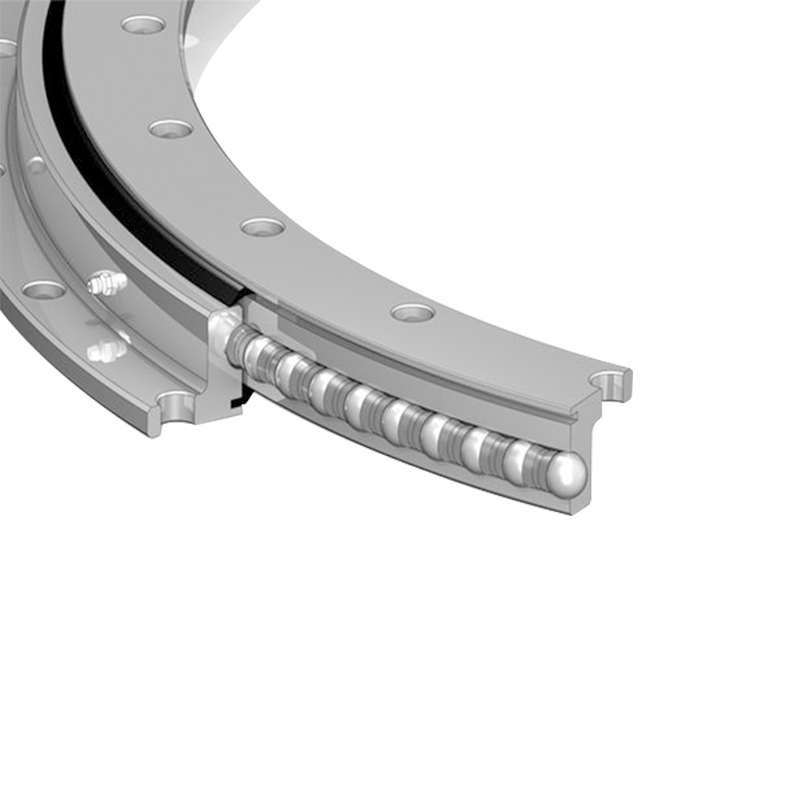
The basic structure of a slewing bearing consists of an inner ring, an outer ring, rolling elements, and a protective system that keeps the bearing clean and lubricated. The main components include:
- Inner and outer rings with hardened raceways that guide the rolling elements.
- Steel balls or cylindrical rollers that carry the load between the rings.
- A cage or spacer that keeps the rolling elements evenly distributed.
- Seals that retain the grease and block dust, water, and debris.
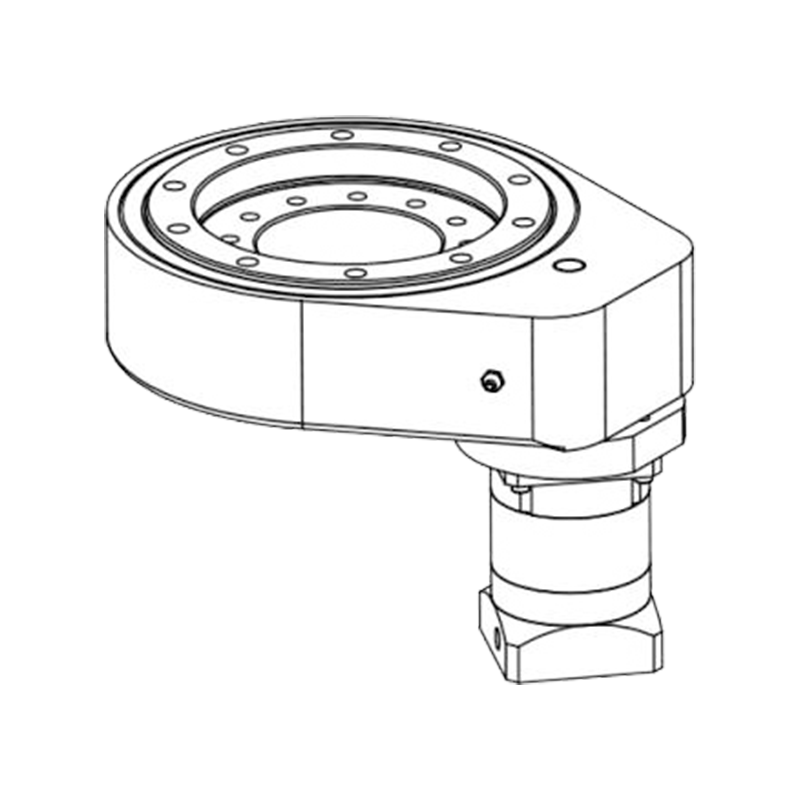
- Optional gear teeth on the inner or outer ring to accept a pinion drive.
In operation, one ring is bolted to the stationary machine frame, and the other ring is bolted to the rotating part. As the rolling elements travel along the raceway, they transfer axial and radial forces from the moving structure to the fixed structure. Because the load-bearing rolling elements act around a large circumference and, in multi-row designs, over several raceway planes, a slewing bearing resists tilting moments that would cause a smaller or narrower bearing to bind or fail.
For a more detailed explanation of the internal raceway arrangement and load path, see our article on the structure and working principle of a slewing bearing.
Common Types of Slewing Bearings
Slewing bearings are classified by the shape and arrangement of their rolling elements. Each type offers a different balance of load capacity, rigidity, and cost.
Among the most widely used designs is the single-row ball type. It uses one row of steel balls and provides a practical balance between load capacity and price for light-to-medium-duty equipment. For compact machines such as robot bases, turntables, and medical scanning tables, a single-row ball slewing bearing is often the most economical solution.
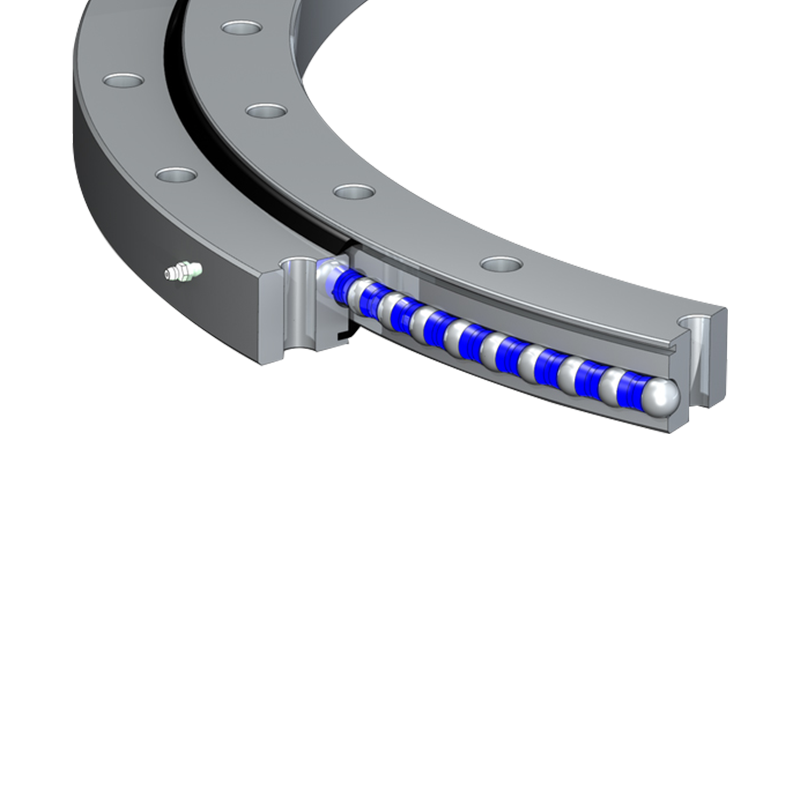 Custom Single-Row Ball Slewing Bearing Manufacturers, Suppliers, FactoryJiangsu Manchen Transmission Technology Co., Ltd is custom Single-Row Ball Slewing Bearing Manufacturers, suppliers & factory in China. T...View Product →
If the application demands higher rigidity and lower clearance, a single-row cross-roller bearing is a better option. Its cylindrical rollers are arranged at right angles to each other, so one bearing can handle axial loads, radial loads, and tilting moments with high precision. This type is common in machine tools and industrial robots.
For medium-duty structures that need more capacity than a single-row design, a double-row ball bearing or an L-type bearing can be used. The L-type design has a compact cross-section that saves height in space-limited installations.
When loads are extreme, a three-row roller bearing becomes the most robust choice. It uses three independent raceways with cylindrical rollers, which gives very high radial and axial capacity together with excellent stability. Large excavators, port cranes, and wind turbines rely on this configuration. If you need a three-row roller slewing bearing, the 13-series is a proven design for the most severe heavy-duty applications.
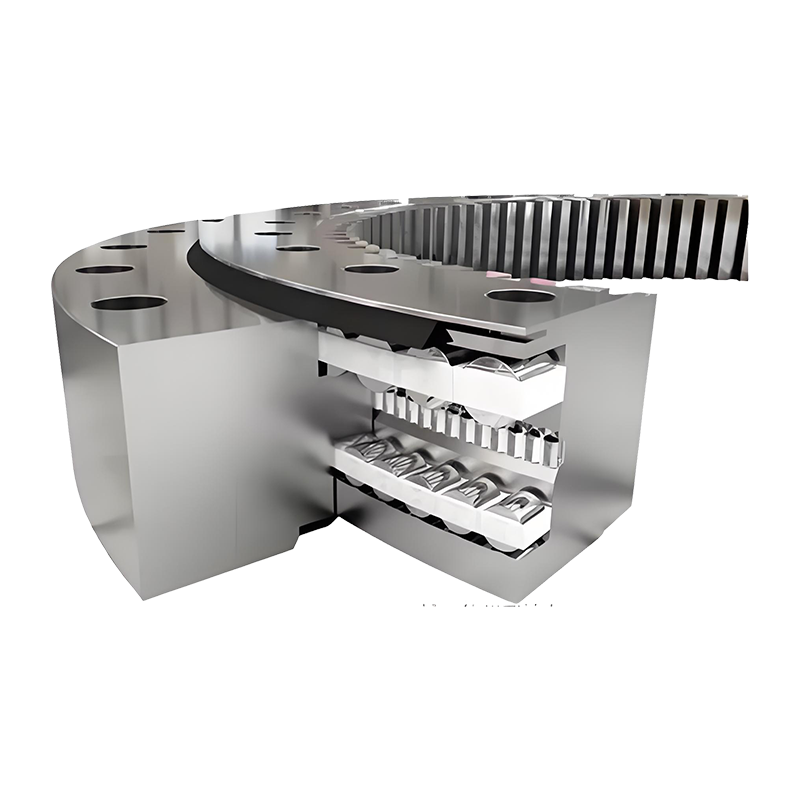 Custom Three-Row Roller Slewing Bearing (13 Series) Manufacturers, Suppliers, FaJiangsu Manchen Transmission Technology Co., Ltd is custom Three-Row Roller Slewing Bearing (13 Series) Manufacturers, suppliers & factor...View Product →
| Type | Rolling elements | Load characteristics | Typical applications |
|---|---|---|---|
| Single-row ball | Steel balls | Moderate axial and tilting load capacity | Robot bases, turntables, compact cranes |
| Single-row cross-roller | Cylindrical rollers crossed at 90 degrees | High rigidity and precision, handles combined loads | Machine tools, industrial robots, medical equipment |
| Double-row ball | Two rows of steel balls | Higher axial and radial capacity than single-row ball | Towers, material handling, medium cranes |
| Three-row roller | Three raceways with cylindrical rollers | Highest capacity and stability for severe loads | Large excavators, marine cranes, wind turbines |
| L-type | Steel balls in a compact L-profile | Saves height while providing moderate capacity | Space-limited rotary joints |
The type of bearing always influences the final bearing envelope, but the manufacturing quality of the raceways and rolling elements can make the difference between a reliable unit and one that fails early.
What to Consider When Choosing a Slewing Bearing
Selection should begin with a clear definition of the load conditions, not with a catalog lookup. The design process usually follows a practical sequence:
- Define the maximum axial force, radial force, and tilting moment that the bearing must carry.
- Choose a bearing type that matches the required precision, rigidity, and allowable envelope.
- Verify gear configuration, mounting dimensions, sealing, and lubrication before finalizing the specification.
Beyond these steps, several key factors determine whether a slewing bearing will perform well in the long term:
- Load capacity and safety factor: Because most slewing bearings rotate slowly, static load capacity and the tilting moment rating are usually more important than dynamic speed life.
- Precision and clearance: Required runout, axial clearance, and preload depend on the positioning accuracy of the machine.
- Gear configuration: Internal gear teeth, external gear teeth, or no gear teeth at all change the drive arrangement and the required pinion design.
- Mounting interface: Bolt hole pattern, flange dimensions, and flatness of the mounting surface affect load distribution and installation ease.
- Sealing and lubrication: Selection depends on exposure to dust, water, chemicals, and the expected maintenance interval.
- Material and heat treatment: Hardened raceways and induction-hardened gear teeth improve wear resistance and service life.
When the load calculation is incomplete, overloading during operation can cause raceway spalling, bolt loosening, or even catastrophic fracture. That is why experienced buyers prefer to give the manufacturer a full load spectrum and mounting layout before asking for a quotation.
Typical Applications Across Industries
Slewing bearings are found anywhere that a large mass must rotate slowly under load. In construction and mining, they carry the rotating superstructures of excavators and cranes. In ports, they allow harbor cranes and ship unloaders to swing heavy loads with precise positioning. In renewable energy, they are used in solar trackers and wind turbines to align equipment with the sun or wind.
Precision applications are just as common. Medical CT scanners rely on slewing bearings for smooth, quiet rotation of the scanning gantry. Industrial robots use them in the base to rotate the arm through wide working ranges. Even environmental equipment such as sludge scrapers and water treatment clarifiers uses large-diameter slewing rings to keep moving parts aligned over long periods.
Since each industry has different demands for speed, accuracy, and environmental resistance, a standard bearing is rarely the final answer. The best approach is to select a type and configuration based on the specific duty cycle and operating environment.
Why Manufacturing Quality Matters
The design of a slewing bearing can look similar on paper from different suppliers, but the finished product can vary greatly in real performance. Raceway hardness, surface finish, grinding precision, and heat treatment consistency all affect load capacity and wear resistance. If the raceways are not accurately aligned, the rolling elements will not share the load evenly, and the bearing will wear faster.
A reliable manufacturer should be able to document material grades, heat treatment results, and final inspection reports. Modern digital production monitoring is also a positive signal because it allows the manufacturer to track quality at every step and maintain consistent output. For heavy-duty applications, asking about raceway hardening depth and gear tooth quality is especially important.
At its core, a slewing bearing is a straightforward but highly engineered component. Once you understand that it must support axial loads, radial loads, and tilting moments simultaneously, the selection process becomes easier. The key is to define the real load envelope, choose the right bearing family, and verify the manufacturing quality before the component is installed in your machine.
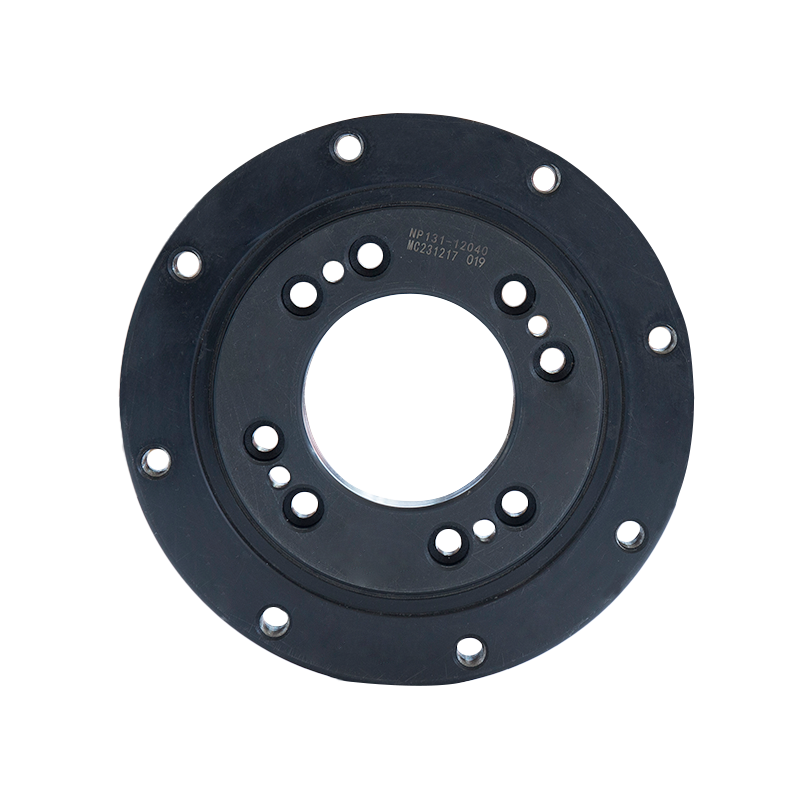

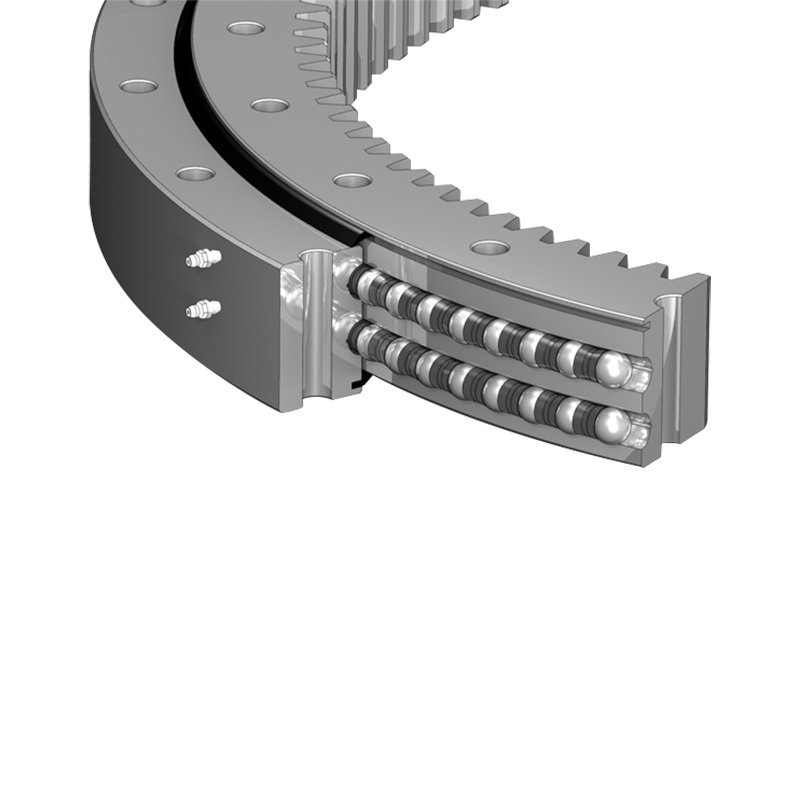


Jiangsu Manchen Transmission Technology Co., Ltd. excels in creating custom, reliable, and precise slewing bearings for diverse industries, continuously innovating to meet the highest standards and seeking collaborative opportunities. Reliable and steady slewing bearings supplier in China.
Product links
Contact Us
-
Address:No. 8, Nanqiu Road, Huangtu Town, Jiangyin City,China
-
Tel:+86-13646122221
-
Phone:+86-18796936198
-
WhatsApp:+86 18796936198
-
E-mail:hedy@slewingbearingcn.com
-
E-mail:ma@slewingbearingcn.com
-
E-mail:vena@slewingbearingcn.com
