

 EN
EN  English
 русский
 Español
 عربى
عربى

News
 Home / News / Industry news / Customized Crane Slewing Ring: How to Specify the Right Bearing for Your Machine
 Customized Crane Slewing Ring: How to Specify the Right Bearing for Your Machine
 2026.10.10
 Industry news
A crane slewing ring rarely comes straight out of a catalogue. The working radius, the load chart, the winch speed, the climate at the site and the gearbox the customer has already ordered all push the design in different directions, and the result is usually a customized crane slewing ring built to a specific drawing. That is the work we do at Jiangsu Manchen Transmission Technology: turning a load case into a ring that fits the bearing seat, the pinion and the maintenance plan of the machine. What follows is how we usually walk through those decisions with crane builders, in the order they tend to come up.
Content
- 1 What "Customized" Actually Covers
- 2 Start With the Crane's Duty Cycle, Not the Ring
- 3 Raceway Families at a Glance
- 4 Heavy-Duty Crane Duty: Three-Row Roller Rings
- 5 Light and Medium Duty: Ball Raceways
- 6 Tight Spaces and Low Section Height
- 7 Sealing, Lubrication and Site Conditions
- 8 From Drawing to Delivery
- 9 A Checklist Before You Approve the Drawing
- 10 Questions Crane Builders Ask Us
What "Customized" Actually Covers
Customization is not only a new bolt-hole pattern. On a crane slewing ring it can touch almost every feature of the part:
- raceway geometry and rolling element size, chosen for the axial load, tilting moment and shock the crane sees;
- outside and inside diameter, bore and section height, so the ring fits an existing mounting pocket;
- gear data, including module, tooth count, pressure angle, tooth hardness and backlash, whether the ring is internally geared, externally geared or ungeared;
- mounting hole count, position, counterbore depth and recommended bolt grade;
- axial and radial clearance class, preload and starting torque;
- seal type, lubrication points, grease channels and surface protection;
- marking, traceability and documentation requirements.
Even a heavily customized ring normally starts from a proven structural family. Choosing that family is the first real engineering decision.
Start With the Crane's Duty Cycle, Not the Ring
Before dimensions are discussed, we ask for the numbers that describe how the crane actually works. A ring that looks generous on paper can still fail early if the duty cycle was described loosely. The questions we need answered are:
- maximum axial load, radial load and tilting moment at each working radius;
- shock and dynamic factors during pick and place, and the static holding condition;
- slewing speed, starts per hour and the share of the shift the crane is working;
- expected service life in hours or revolutions;
- ambient temperature, humidity, salt exposure, dust and wash-down practices;
- mounting interface: seat flatness, bolt grade, hole pattern and available section height.
If some of these are still open, say so. It is far cheaper to discuss them before the drawing is fixed than to find a mismatch during assembly.
Raceway Families at a Glance
Almost every crane slewing ring belongs to one of five structural families. They differ in how the rolling elements carry load, and therefore in what they can do under a tilting moment.
| Ring type | Rolling elements | Load character | Typical crane duty |
|---|---|---|---|
| Single-row ball (four-point contact) | One row of balls | Axial load, moderate moment | Light jib cranes, small marine cranes, turntables |
| Double-row ball | Two rows of balls | Higher axial load and moment | Medium cranes, deck cranes, stacker cranes |
| Three-row roller (13 series) | Two axial roller rows plus one radial row | Very high axial, radial and moment, good shock resistance | Port, shipyard, offshore and heavy mobile cranes |
| Single-row crossed roller | Cylindrical rollers crossed at 90 degrees | Radial and axial load with precise tilt control | Precision turntables, compact lifting equipment |
| L-type single-row ball | Balls in an L-shaped ring geometry | Axial load, low section height, limited moment | Aerial platforms, low-profile cranes, compact automation |
The table is a starting point, not a decision. Two cranes with the same load chart can still need different rings if one works continuously and the other lifts a few times an hour.
Heavy-Duty Crane Duty: Three-Row Roller Rings
When a crane works hard all day, grabbing, lifting and slewing under shock, the ring has to spread that load across enough rolling contact to keep stress low. In a three-row roller design, two rows of cylindrical rollers take the axial load and the tilting moment, while a third row takes the radial load from the gearing. The arrangement is stiff, tolerant of shock and well suited to the port and shipyard schedules that fill most heavy crane work. For a closer look at how these rings behave on real machines, our crane and excavator guide walks through the mechanics.
This is also the family where customization matters most, because diameters, roller sizes, gear data and mounting interfaces change from project to project.
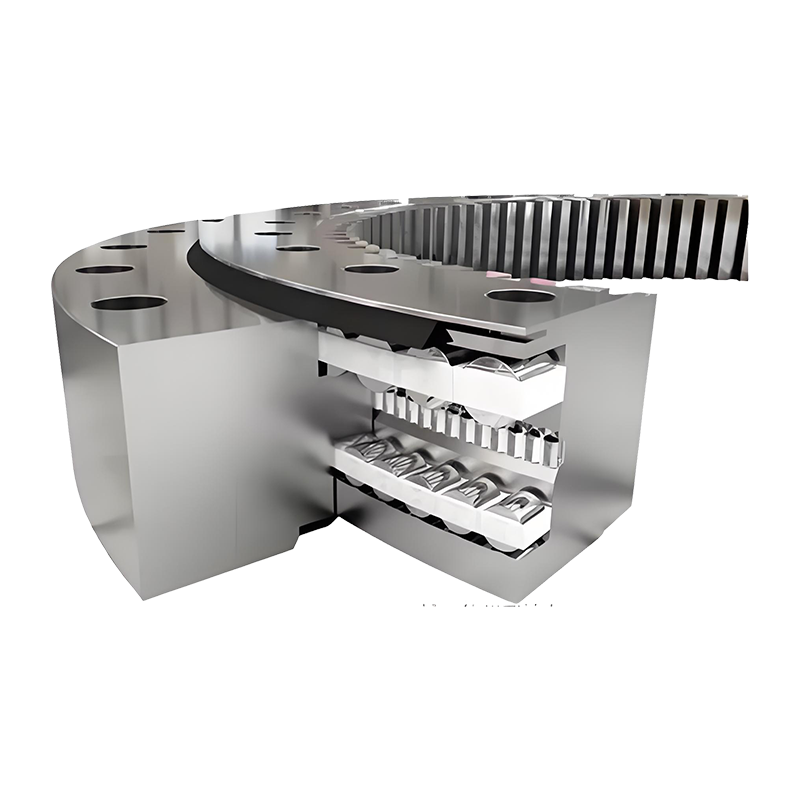 Three-Row Roller Slewing Bearing 13 SeriesThree-row roller design handles axial and radial loads, with customization across diameters, roller sizes, gears, and mounting interfaces for cranes and port equipment.View Product →
Light and Medium Duty: Ball Raceways
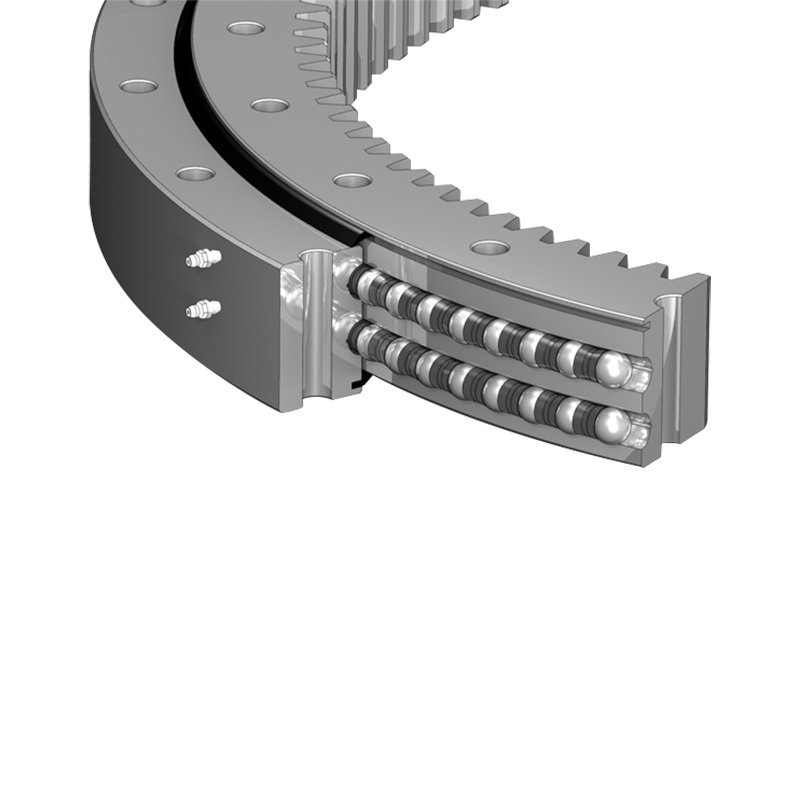
Not every crane needs a roller ring. Where the tilting moment stays moderate and the machine slews gently, a single-row ball ring gives a lower-cost, lower-friction solution that is easier to seal and relubricate. Four-point contact single-row rings are a common choice for small jib cranes, marine cranes and non-geared turntables, while double-row versions add capacity for medium cranes that lift further out.
The honest advice here is often to spend less. If the duty data shows the moment stays modest, a ball ring with a properly hardened gear will outlast an oversized roller ring that never gets enough movement to distribute grease.
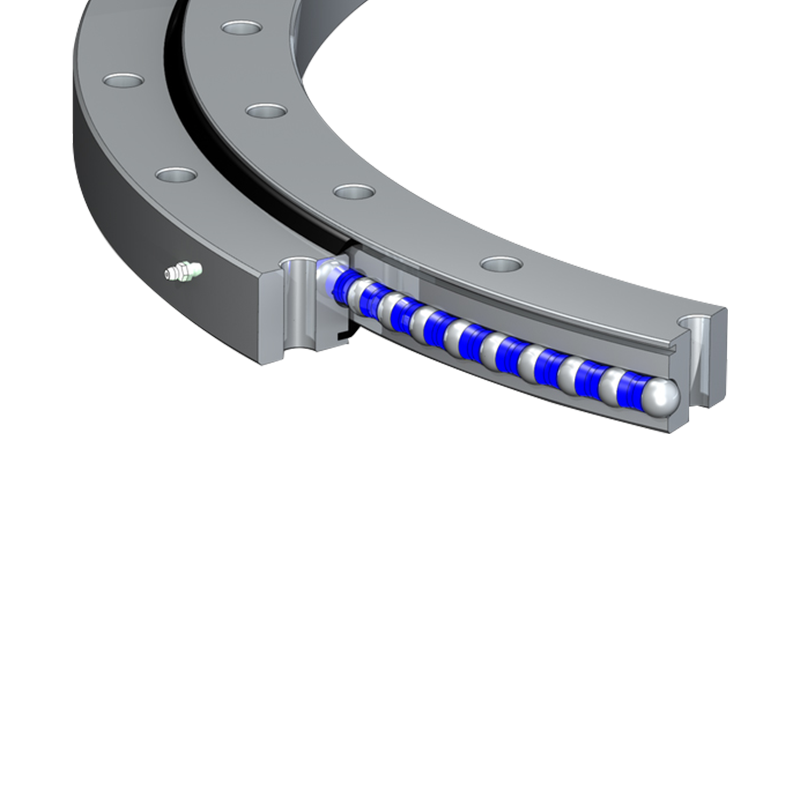 Single-Row Ball Slewing Bearing SeriesCompact single-row ball bearing gives smooth rotation, axial and radial load support, sealing choices, and Q/01/HS gear variants for machinery, medical, and marine uses.View Product →
Tight Spaces and Low Section Height
Some cranes are limited by height rather than by load. Aerial platforms, compact knuckle-boom cranes and robotic turntables often have only a shallow mounting pocket to work with. An L-type single-row ball ring keeps the section compact while still carrying axial load, and it can be supplied with internal or external gearing to suit the drive position.
The trade-off is tilting moment capacity. If the machine can be pushed out of balance during a pick, a taller ring is usually the more durable answer, even when the drawing says it barely fits.
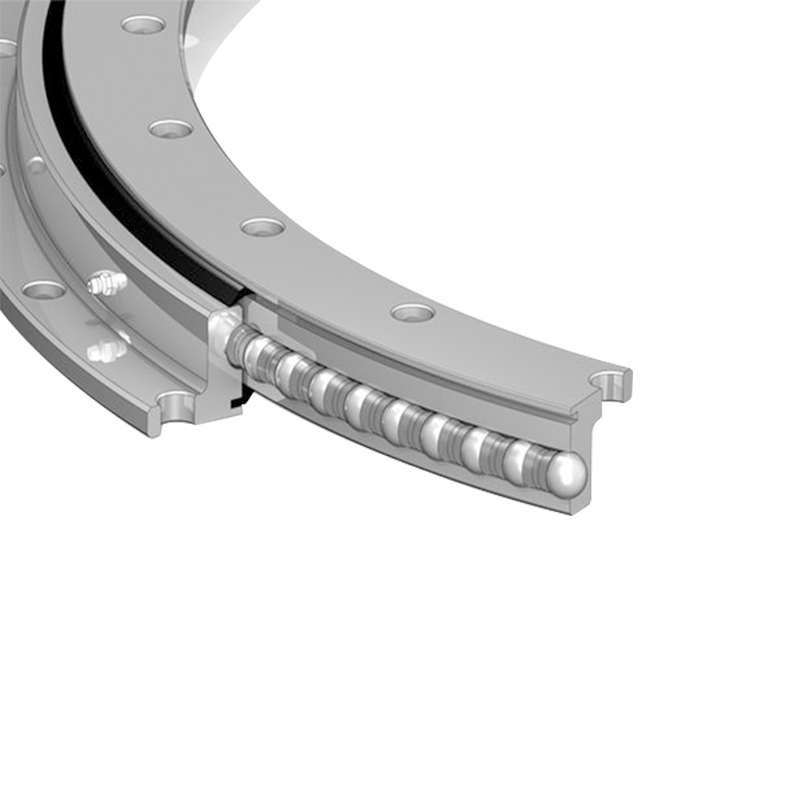 L-Type Single Row Ball Slewing BearingCompact L-shaped single-row ball bearing handles axial, radial, and moment loads, making it worth reviewing when tilting capacity and space both matter.View Product →
Sealing, Lubrication and Site Conditions
Raceway life is decided as much by what reaches the ring as by how it was made. Salt air at a port, abrasive dust at a quarry, steam cleaning at a processing plant and sub-zero starts each call for a different seal and grease.
We normally match the seal, single lip, double lip or labyrinth with a lip, to the contamination risk, place grease nipples where the maintenance team can actually reach them, and set a relubrication interval based on ring size and the number of slewing cycles per shift. Surface protection follows the same logic: a standard painted finish is fine inland, while offshore work usually justifies a heavier coating and plated fittings.
When a ring already in service runs warm, makes noise or pushes grease out of the wrong place, the causes are usually predictable. Our notes on slewing ring troubleshooting cover the common ones.
From Drawing to Delivery
Custom rings are built to order, so the process matters as much as the design. It usually runs like this:
- we review the drawing and the load data, then come back with questions about a tolerance that can be relaxed, a hole pattern that can be simplified or a seal that suits the site better;
- the drawing is confirmed and manufacturing data is released to the shop floor;
- ring rolling, turning, raceway hardening and grinding, gear cutting and tooth hardening follow, each with in-process checks;
- assembly and inspection cover clearance, starting torque, gear runout and backlash, plus a final dimensional report;
- packing with the agreed protection, marking and documentation, then shipping.
Production is monitored through an integrated data system, so when you ask where your order stands, we answer from records rather than from memory.
A Checklist Before You Approve the Drawing
- Load figures confirmed at every working radius, including the worst case.
- Raceway family matched to duty, not to habit.
- Gear data checked against the actual pinion, with backlash allowance for heat and wear.
- Section height and diameter measured against the real mounting pocket, not an old drawing.
- Clearance class and starting torque specified and testable.
- Seal, grease and relubrication points chosen for the site, not for the workshop.
- Bolt grade, torque, tightening sequence and seat flatness written on the drawing.
- Documentation, marking and packaging requirements listed before production starts.
Questions Crane Builders Ask Us
Can you modify a standard ring instead of making a new one?
Often yes. If the change is limited to the bore, gear teeth, hole pattern or lubrication points, working from an existing size shortens both the engineering time and the lead time.
What do you need to quote a customized ring?
A drawing or sketch, the load figures, slewing speed and duty, the working environment and the quantity. If the drawing is not finished yet, the load data alone is enough for us to suggest a sensible starting point.
A customized crane slewing ring is a conversation before it is a product. If you have a load case, a worn ring or a drawing with open questions, send it over. We will tell you honestly what we would change, what we would keep and what it would take to build it.
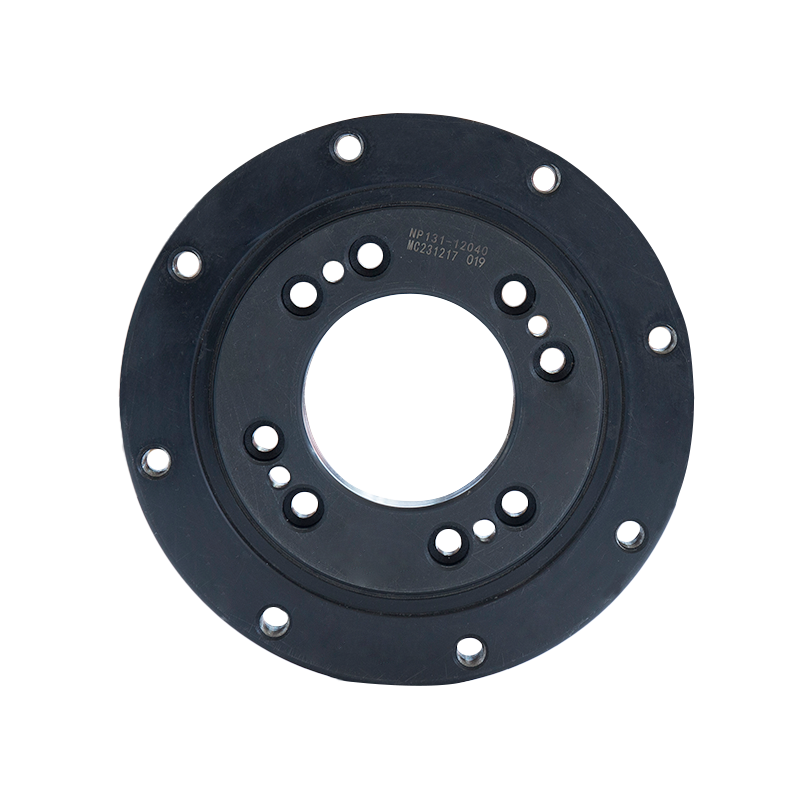

Jiangsu Manchen Transmission Technology Co., Ltd. excels in creating custom, reliable, and precise slewing bearings for diverse industries, continuously innovating to meet the highest standards and seeking collaborative opportunities. Reliable and steady slewing bearings supplier in China.
Product links
Contact Us
-
Address:No. 8, Nanqiu Road, Huangtu Town, Jiangyin City,China
-
Tel:+86-13646122221
-
Phone:+86-18796936198
-
WhatsApp:+86 18796936198
-
E-mail:hedy@slewingbearingcn.com
-
E-mail:ma@slewingbearingcn.com
-
E-mail:vena@slewingbearingcn.com
