

 EN
EN  English
 русский
 Español
 عربى
عربى

News
 Home / News / Industry news / Crane Parts and Functions: A Complete Guide to Every Key Component and System
 Crane Parts and Functions: A Complete Guide to Every Key Component and System
 2026.09.30
 Industry news
A crane looks simple from a distance. A load goes up, the boom swings across the site, the hook comes back down, and everyone on the ground assumes the next cycle will look exactly the same. Behind that repeatable motion sits a large family of components, each with a narrow and well-defined job, and each one quietly influencing how safe and how smooth the lift will be.
Understanding crane parts and functions matters well beyond passing a technical exam. Operators who can picture what is happening beneath the deck, maintenance teams who can trace a symptom back to its source, and engineers selecting replacement components all make better decisions when they see the machine as a connected system. In this guide we walk through the main crane assemblies, explain what each part does, and pay particular attention to the rotating components that often decide how a crane feels in daily service.
Content
- 1 Crane Parts at a Glance: Lower Works and Upper Works
- 2 The Lifting Structure: Boom, Jib, and Counterweight
- 3 The Hoist System: Winches, Rope, Hook, and Sheaves
- 4 The Slewing System: The Parts That Turn the Crane
- 5 Power, Control, and Operator Systems
- 6 Crane Parts and Functions: A Quick Reference Table
- 7 Safety Devices and Load Management
- 8 Matching Crane Parts to the Job
- 9 Maintenance Habits That Extend Crane Life
Crane Parts at a Glance: Lower Works and Upper Works
Almost every crane, from a compact truck-mounted unit to a heavy crawler machine, can be divided into two cooperating halves. The lower works carry the machine and hold it steady. The upper works do the lifting and the swinging.
The lower works usually include:
- A carrier or undercarriage that provides mobility and a rigid foundation
- Outriggers on mobile cranes, or crawler tracks on lattice-boom machines, which spread load into the ground
- The carrier frame and drive train, including engines, axles, and steering
- Jacking cylinders, floats, and outrigger beams used to level the crane before a lift
The upper works, often called the superstructure, rotate as one assembly and typically contain:
- The revolving frame that ties the boom, machinery, and counterweight together
- Boom, jib, and mast structures
- Hoist and boom winches together with their ropes and sheaves
- The operator cab, control systems, and safety electronics
- The slewing bearing and slewing drive that connect upper and lower works and make rotation possible
That last group deserves a closer look, because a crane that lifts well but swings poorly is a crane that nobody enjoys operating.
The Lifting Structure: Boom, Jib, and Counterweight
The boom is the crane's reach. Telescopic booms use hydraulic cylinders to extend and retract nested sections, which makes them fast to set up and ideal for mobile work. Lattice booms are built from a truss of chords and lacing, and although they take longer to assemble, they offer very high strength-to-weight ratios for long reaches and heavy picks.
The jib extends the working radius beyond the main boom tip, allowing a crane to reach positions the boom alone cannot cover. On many machines the jib can be offset at an angle, which is useful when lifting close to a wall or behind an obstruction. The mast or boom hoist structure supports the pendant ropes and controls boom angle.
The counterweight balances the load. Its mass is positioned behind the slewing centre so that the overturning moment created by the load is partly offset. Counterweight configurations are usually adjusted for each job: more counterweight allows heavier picks at short radii, while less counterweight suits long-radius work and reduces ground bearing pressure. Understanding this trade-off is one of the most practical crane functions to master, because it directly affects capacity charts and site planning.
The Hoist System: Winches, Rope, Hook, and Sheaves
The hoist system is what actually raises and lowers the load, and its parts work as a chain:
- The hoist winch drum stores the wire rope and rotates under the control of a hydraulic or electric motor
- The winch gearbox multiplies motor torque into usable line pull
- The brake holds the load when the operator releases the control
- Wire rope carries the load and must be inspected for broken wires, crushing, and corrosion
- Sheaves guide the rope and determine the number of parts of line, which sets the relationship between line pull and lifting capacity
- The hook block or overhaul ball provides the interface between the rope and the rigging
Adding more parts of line reduces the load on each rope segment and increases lifting capacity, at the cost of hoist speed. Choosing the right reeving is therefore a balance between the weight being lifted and the cycle time the job demands.
The Slewing System: The Parts That Turn the Crane
The slewing system is the heart of crane rotation, and it consists of two main components: the slewing bearing and the slewing drive.
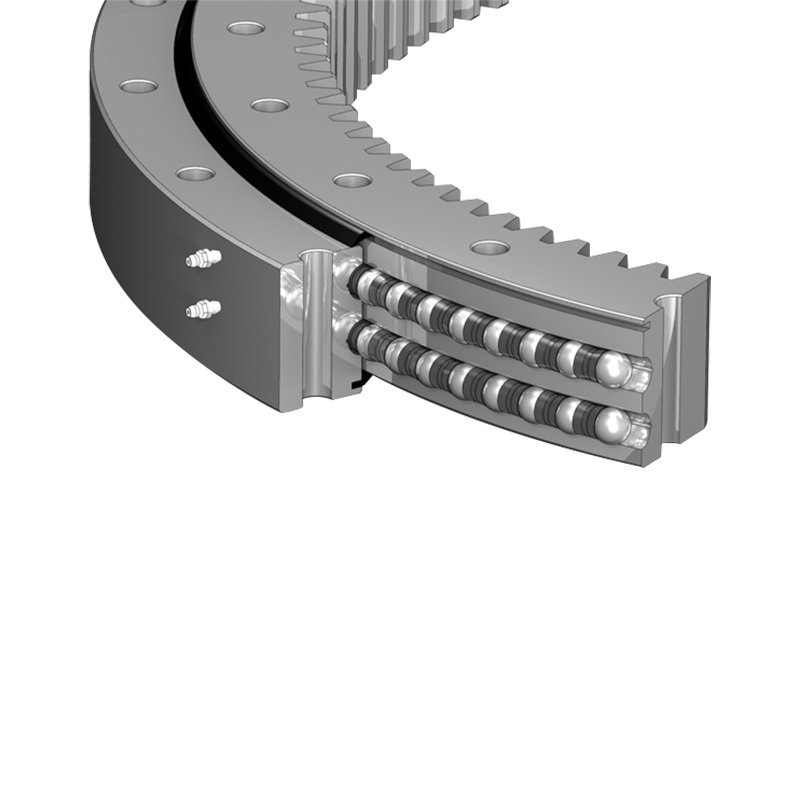
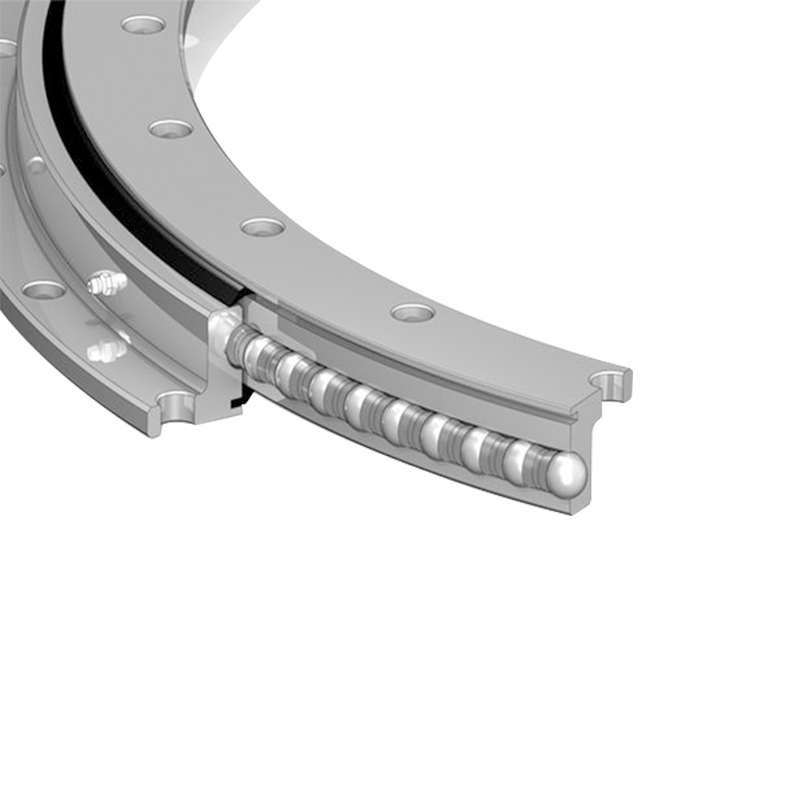
The slewing bearing, also called a slewing ring, is a large rolling-element bearing that sits between the lower and upper works. Its inner and outer rings carry raceways, rolling elements, gear teeth on one ring, seals, and lubrication channels. Because the bearing must simultaneously carry axial load from the weight of the superstructure, radial load from the boom, and significant tilting moments from the load at radius, its internal geometry is carefully matched to the application. Single row ball slewing bearings suit lighter, faster machines that need low friction and quick rotation. Double row ball designs add capacity. Three row roller slewing bearings, including the widely used 13 series, use three separate raceways so that axial, radial, and tilting loads are each handled by rollers arranged for that specific direction. Crossed roller and L-type single row bearings offer compact, stiff solutions for high precision applications.
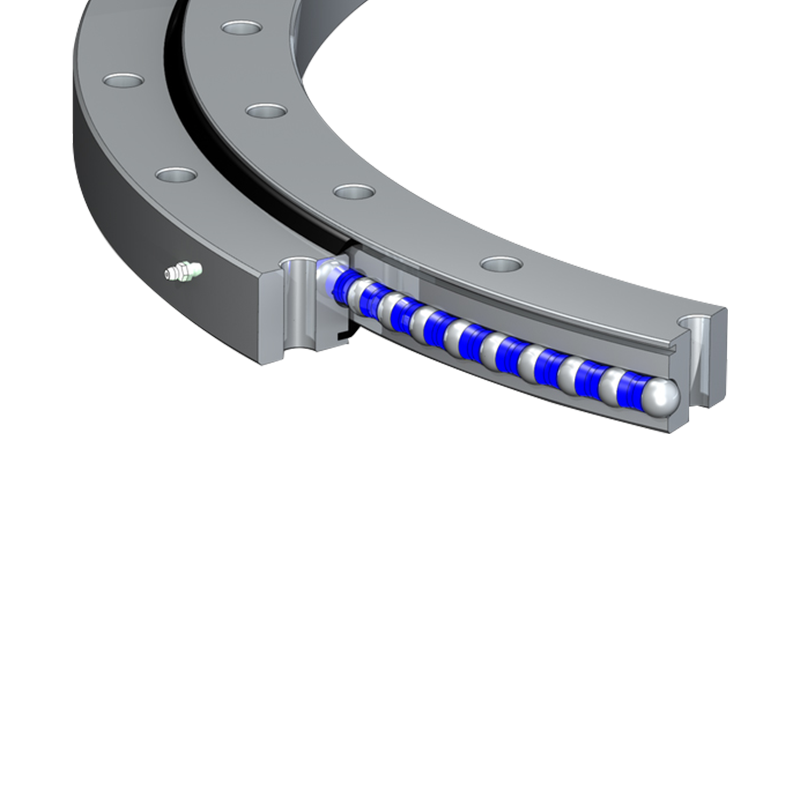 Single-Row Ball Slewing Bearing for Smooth Rotational SupportCompact single-row ball slewing bearing uses high-strength steel balls for axial and radial loads, low friction, sealing options, and stable rotation in construction, wind, medical, and marine equipment.View Product →
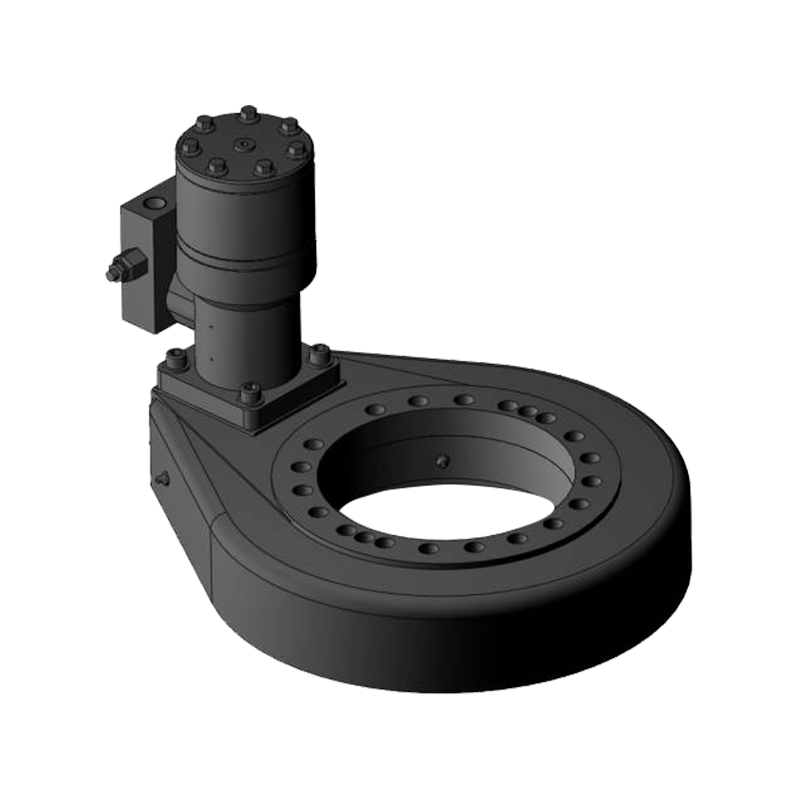
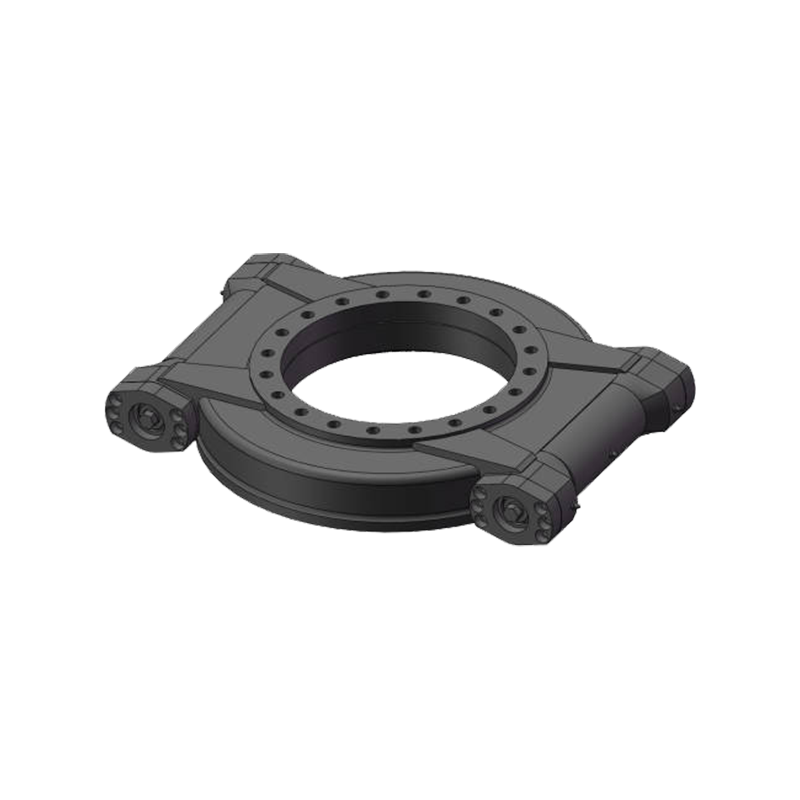
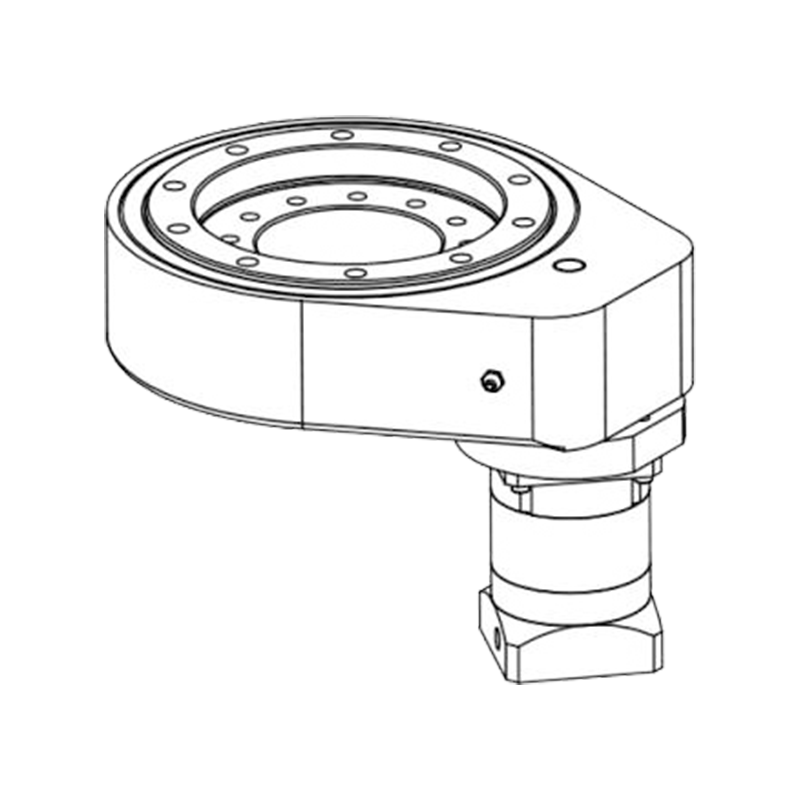
The slewing drive supplies the turning force. A motor drives a planetary gearbox, and a pinion on the output shaft meshes with the gear teeth on the bearing ring. A brake holds the superstructure steady when rotation stops. The condition of the pinion, the gear teeth, and the gearbox lubrication determines whether rotation stays smooth and precise over thousands of working hours. If you want to see how these principles play out on real machines, our engineering team has published a practical article on how slewing bearings work in cranes and excavators.
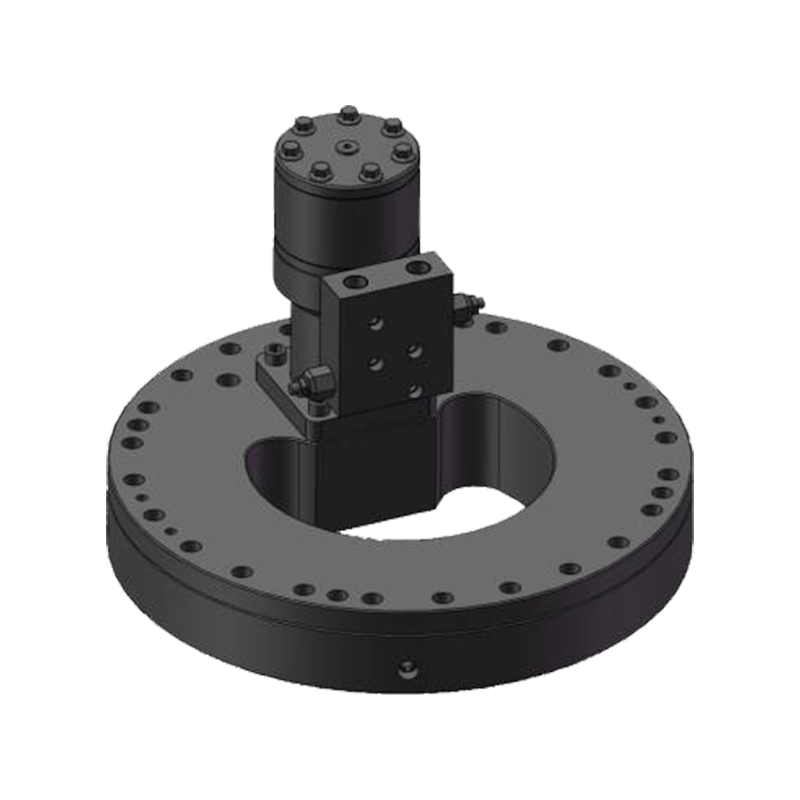 Vertical Internal Gear Slewing Drive with Self-LockingVertical internal gear slewing drive offers efficient torque transmission, self-locking position holding, and space-saving stability for lifting, tilting, rotating, construction, material handling, and renewable energy equipment.View Product →
For heavy-duty cranes, the combination of a three row roller bearing and a robust, well-sealed slewing drive is often what separates a machine that stays productive from one that spends its life in the workshop.
Power, Control, and Operator Systems
The power system converts stored energy into useful motion. Hydraulic pumps, control valves, and cylinders drive boom extension, luffing, outrigger deployment, and often the slewing drive itself. Electrical systems manage starting, instrumentation, lighting, and the sensor network that feeds the crane's computer.
In the cab, joysticks and pedals translate operator intent into valve commands, and the crane reacts. Modern cabs are also information hubs: load charts, radius readouts, boom angle, and fault codes all appear in front of the operator, so the cab is as much a monitoring station as it is a control room.
Crane Parts and Functions: A Quick Reference Table
| Part | Primary Function | Typical Location |
|---|---|---|
| Boom | Extends lift height and working reach | Upper works |
| Jib | Adds radius beyond the main boom tip | Boom tip |
| Counterweight | Balances load and improves stability | Rear of upper works |
| Hoist winch | Raises and lowers the load line | Revolving frame |
| Wire rope and sheaves | Transmit load force and guide the rope | Boom tip and hook |
| Hook block | Connects rigging to the load line | End of load line |
| Slewing bearing | Supports rotation and carries combined loads | Between upper and lower works |
| Slewing drive | Provides controlled rotation and braking | Upper works, meshed with ring gear |
| Outriggers | Stabilise the crane and spread ground pressure | Lower works |
| Load moment indicator | Monitors load and radius, warns of overload | Cab and boom sensors |
Safety Devices and Load Management
Safety devices are not accessories; they are part of the crane's core function. A load moment indicator continuously compares actual load and radius against the rated capacity chart and warns or stops the machine before an overload develops. Anti-two-block systems prevent the hook block from contacting the boom tip. Limit switches restrict boom extension, luffing range, and hoist travel. Slew brakes and locks secure the superstructure when the machine is parked or when wind loading becomes significant.
Together these devices protect the structure, the rope, and the people working below. They also make the crane predictable, which is ultimately what every lift plan depends on.
Matching Crane Parts to the Job
Selection starts with the duty cycle. A machine lifting light loads at high frequency needs low rotational friction and consistent precision. A machine lifting heavy loads at long radius needs maximum tilting moment capacity and a stiff bearing arrangement. Environment matters too: dust, salt spray, and temperature extremes all affect seal choice, lubrication interval, and surface protection.
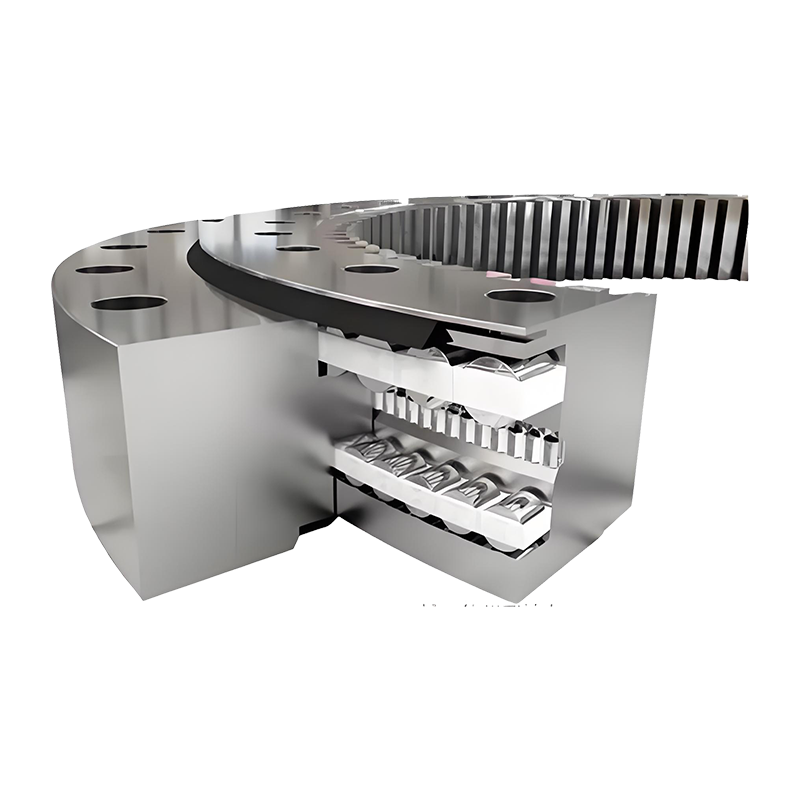 Three-Row Roller Slewing Bearing for Heavy-Duty MachineryThe 13 Series three-row roller bearing distributes axial and radial loads across separate roller rows, using high-strength alloy steel for cranes, excavators, tower cranes, and port handling equipment.View Product →
As a slewing bearing and slewing drive manufacturer, we work with crane builders and operators to translate these requirements into a concrete specification. That may mean a three row roller bearing for a heavy crawler crane, a single row ball bearing for a compact mobile unit, or a sealed slewing drive with an integrated brake for a machine working in a coastal yard. You can explore our full range of slewing bearings and slewing drives to see how each design addresses a different balance of load, precision, and service life.
Maintenance Habits That Extend Crane Life
Most crane failures develop slowly, and the parts that rotate are usually the first to warn you. A practical routine includes:
- Grease the slewing bearing raceways at the interval recommended for the application and climate
- Inspect seals for cracking, displacement, or leakage that allows water and grit into the raceway
- Check gear tooth wear and backlash between the pinion and the ring gear
- Verify the torque of mounting bolts, since loosening changes load distribution
- Listen and feel for unusual noise, vibration, or roughness during slow rotation
- Record findings over time so that trends become visible before they become failures
These steps take minutes and prevent the kind of downtime that takes days.
Crane parts and functions are easiest to remember when they are grouped by purpose: the structure that reaches, the hoist that lifts, the slewing system that turns, and the controls and safety devices that keep everything within limits. Once that picture is clear, choosing, operating, and maintaining a crane becomes far more logical, and the components at the centre of rotation stop being mysterious.
If you are specifying a slewing bearing or slewing drive for a new crane or a retrofit, our engineers are happy to review your load case, duty cycle, and mounting arrangement, and to recommend a configuration that fits the work you actually do.
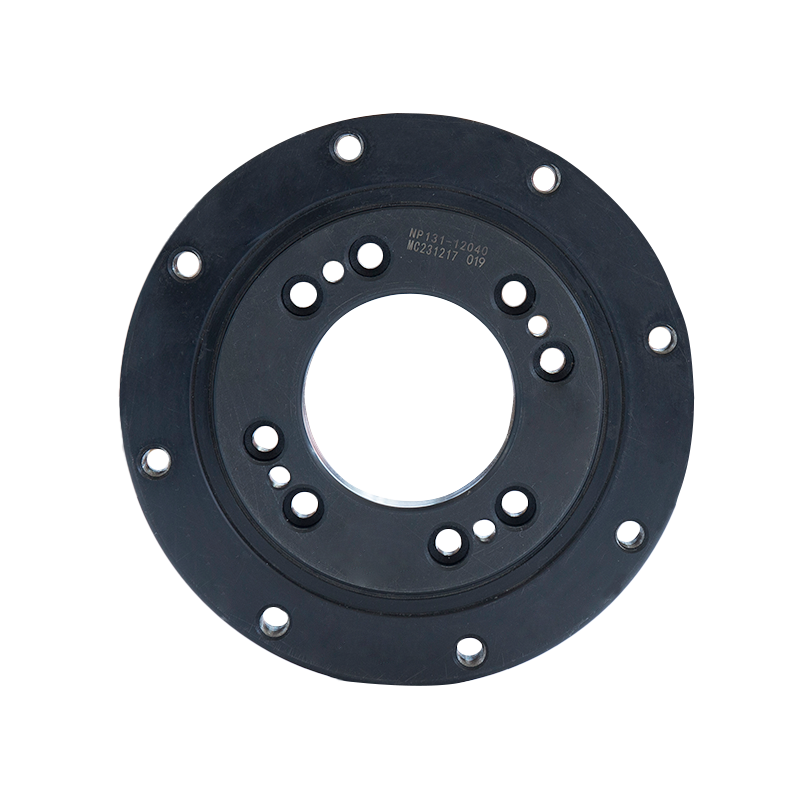




Jiangsu Manchen Transmission Technology Co., Ltd. excels in creating custom, reliable, and precise slewing bearings for diverse industries, continuously innovating to meet the highest standards and seeking collaborative opportunities. Reliable and steady slewing bearings supplier in China.
Product links
Contact Us
-
Address:No. 8, Nanqiu Road, Huangtu Town, Jiangyin City,China
-
Tel:+86-13646122221
-
Phone:+86-18796936198
-
WhatsApp:+86 18796936198
-
E-mail:hedy@slewingbearingcn.com
-
E-mail:ma@slewingbearingcn.com
-
E-mail:vena@slewingbearingcn.com
