

 EN
EN  English
 русский
 Español
 عربى
عربى

News
 Home / News / Industry news / Slew Ring Excavator Guide: Bearing Types, Selection, and Maintenance Tips
 Slew Ring Excavator Guide: Bearing Types, Selection, and Maintenance Tips
 2026.10.15
 Industry news
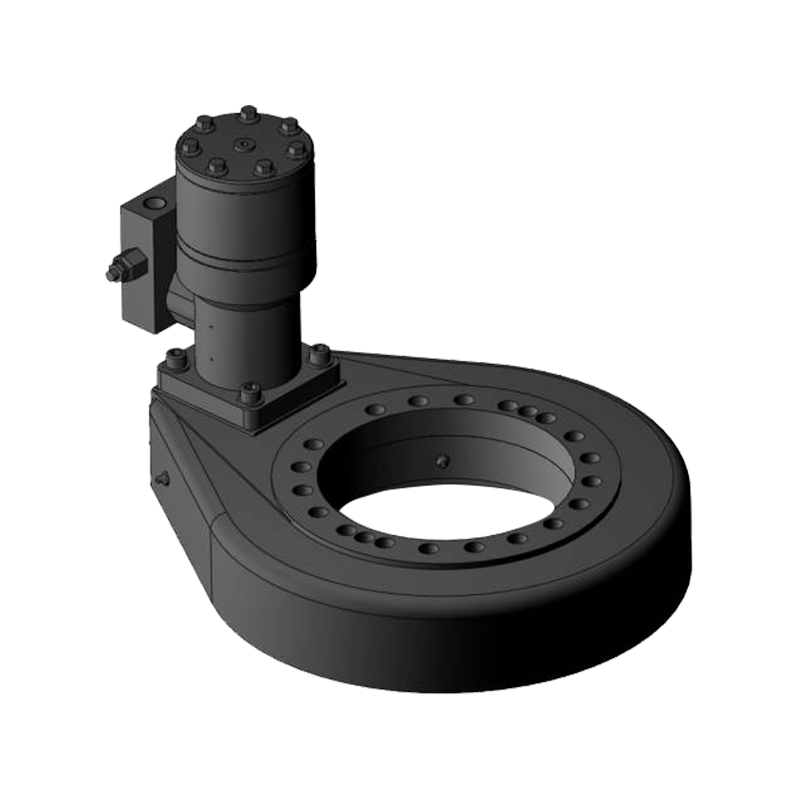
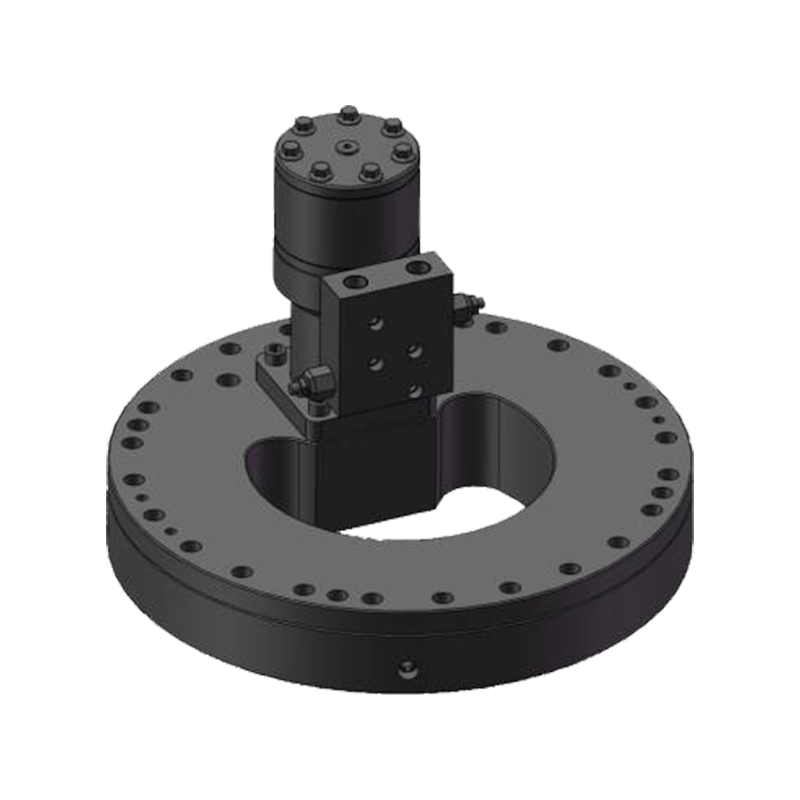
You can judge an excavator by the way it swings. That smooth, controlled rotation of the upper structure happens on one large component sitting at the machine's waist: the slew ring, also called a swing bearing or slewing ring bearing. It carries everything above it, absorbs the tilting force of a loaded boom at full reach, and passes swing torque into the toothed race.
This guide walks through what a slew ring does on an excavator, which bearing types suit which machine class, the wear signs worth catching early, and the maintenance routine that keeps a swing feeling tight.
Content
- 1 What a Slew Ring Does on an Excavator
- 2 Slewing Ring Types and Where They Fit
- 3 Reading a Slew Ring Specification
- 4 Warning Signs of a Failing Slew Ring
- 5 Maintenance Habits That Extend Swing Bearing Life
- 6 Matching the Bearing to Machine Class and Duty Cycle
- 7 Working With a Manufacturer Who Knows Excavators
What a Slew Ring Does on an Excavator
The slew ring is the structural joint of the machine. The upper frame bolts to one ring, the undercarriage bolts to the other, and the house rotates on the rolling elements between them. In service, three load types arrive at the same time:
- Axial load, from the dead weight of the upper structure plus whatever is in the bucket.
- Tilting moment, from a loaded boom reaching out, which presses one side of the raceway far harder than the other.
- Radial load and swing torque, from acceleration and braking, delivered through the gear teeth by the swing gearbox pinion.
Because those loads change constantly and arrive together, a slew ring is designed as a structural element, not a simple bearing. Race diameter, bolt circle, gear module and material specification are all part of the machine's design, which is why replacing one is a workshop job rather than a roadside repair.
Slewing Ring Types and Where They Fit
Excavator slew rings are grouped by how their rolling elements are arranged, and each arrangement has a natural machine class behind it.
Single Row Ball Slewing Bearings
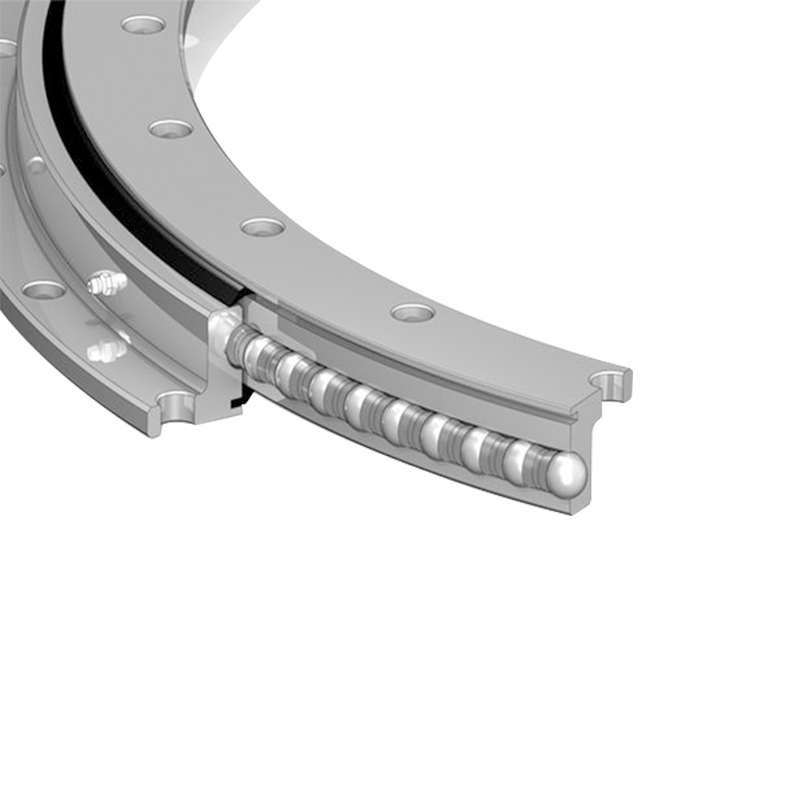
Single row ball slewing bearings are the most common choice for compact and mid-size excavators. Four-point contact geometry lets a single row of balls carry axial, radial and moment loads at once, so the bearing stays short while remaining stiff enough for everyday digging. They mount simply, cost less than roller designs, and come with internal or external gearing to match the swing gearbox layout.
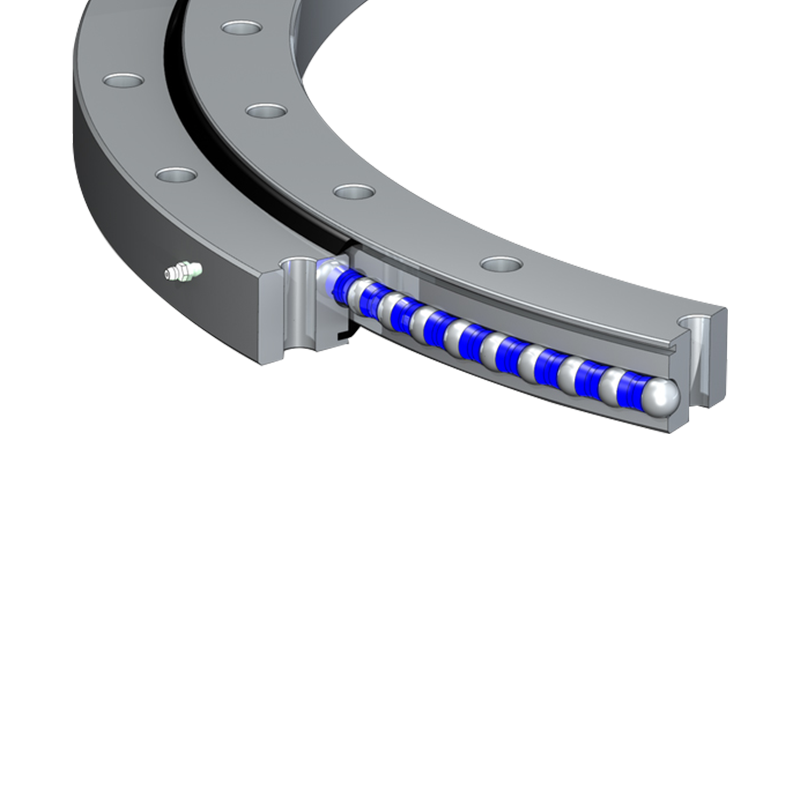 Single-Row Ball Slewing Bearing for ExcavatorsFits compact and mid-size excavators, carrying axial, radial and moment loads with a short, stiff single-row design and optional gearing.View Product →
Double Row Ball Slewing Bearings
When the boom gets longer, the tilting moment climbs faster than the payload does. A double row equal-diameter four-point contact ball bearing shares that moment across two rows of balls, adding capacity without a dramatic change in mounting height. It suits mid-size machines that spend their days with long arms, grabs or grapples fitted, where the load often sits well off centre.
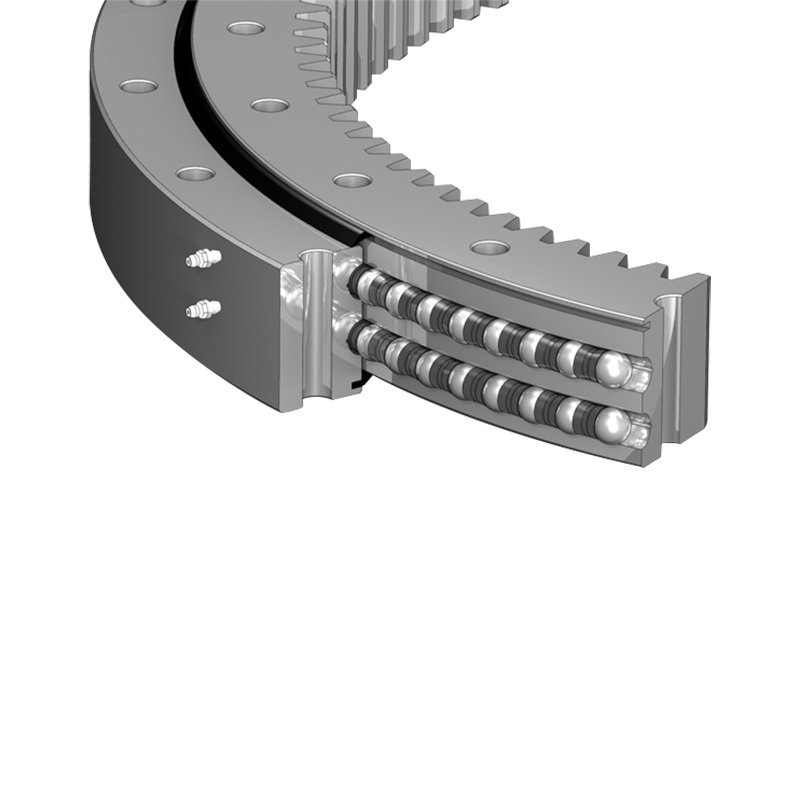 Double-Row Equal-Diameter Four-Point Contact Ball Slewing BearingAdds capacity for mid-size machines with long arms or grapples by sharing tilting moment across two rows without a major mounting-height increase.View Product →
Three Row Roller Bearings (13 Series)
Large mining, quarry and demolition machines need more than a ball bearing can offer. A three row roller slewing bearing uses one row of rollers for axial load in each direction and a third row for radial load, which delivers very high capacity and stiffness. The 13 series is built for that duty: it shrugs off shock loads from rock digging and holds rotational accuracy under a heavy bucket. It is also heavier, more costly, and less forgiving of a poorly machined mounting surface.
Cross Roller and L-Type Options
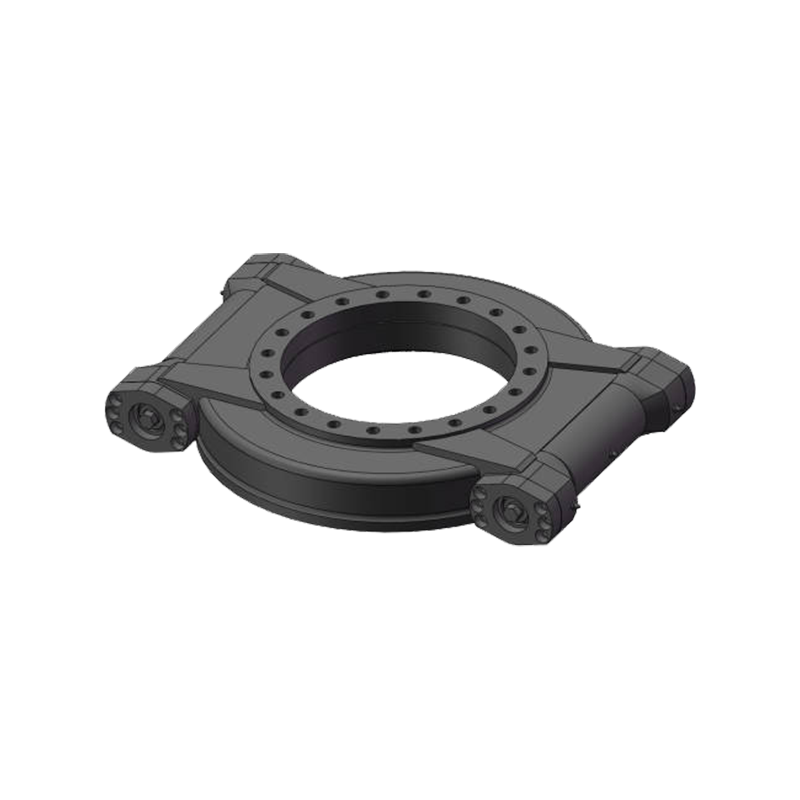
Two smaller families are worth knowing. Single row cross roller bearings place cylindrical rollers at ninety degrees to each other in one raceway, giving high stiffness in a shallow height. L-type single row ball bearings use an L-shaped inner ring that bolts straight to a vertical mounting face. Both appear in compact excavators and powered attachments where space is tight and rotational accuracy matters.
Reading a Slew Ring Specification
Specification sheets give numbers; the skill is knowing which numbers matter. On an excavator slew ring, four parameters drive most decisions: the axial and moment ratings, the gear module that matches the swing gearbox pinion, the bolt hole pattern, and the overall height available under the house.
| Bearing type | Load behaviour | Typical machine class | Practical notes |
|---|---|---|---|
| Single row ball | Good axial and moment capacity at moderate loads | Compact and mid-size excavators | Cost-effective, simple mounting, internal or external gear |
| Double row ball | Higher tilting moment capacity than single row | Mid-size machines with long reach | Two ball rows share the overturning load |
| Three row roller (13 series) | Very high axial, radial and moment capacity | Large mining and quarry excavators | Rigid, shock-resistant, heavier and more expensive |
| Cross roller and L-type | High precision under combined loads | Small machines and attachments | Compact height, tight rotational accuracy |
Bearings are rated against a defined load case and a target life, often counted in swing cycles. A machine digging eight hours a day in a quarry and a machine doing utility work twice a week may look similar on paper but need very different safety factors.
Warning Signs of a Failing Slew Ring
Slew rings rarely fail without warning. The difficulty is that the warnings appear gradually, and operators adapt to them without noticing. Watch for:
- Growing backlash, where the house rocks slightly as a swing starts or stops.
- New noise or vibration, such as grinding, clicking or a rough patch in the rotation.
- Grease that turns dark, gritty or metallic, or grease pushing past the seals.
- Leaking, cracked or torn seals, which let dust and water straight into the raceway.
- Loose or stretched mounting bolts, a common cause of serious failure that is easy to check.
- Uneven wear on the gear teeth, usually a sign of misalignment or a worn pinion.
If two or more of these appear together, step back from heavy digging and have the bearing inspected. Replacing a bearing early costs far less than one that fails and takes the mounting flange with it.
Maintenance Habits That Extend Swing Bearing Life
Slew ring maintenance is not complicated, but it does have to be regular.
- Grease to a schedule, not by feel. Use an extreme-pressure grease matched to the duty and follow the recommended interval.
- Rotate while greasing, so the grease spreads around the whole raceway instead of collecting in one spot.
- Inspect the seals at every service; a torn seal is an open door for dust and water.
- Read the old grease. If it comes out gritty or metallic, have a sample checked.
- Verify bolt torque, and re-torque after the first weeks of operation as a matter of routine.
- Keep the area around the ring clean, since packed debris holds moisture against the seals.
For a broader look at how these bearings behave on different machines, our guide to slewing bearings on cranes and excavators pairs well with a maintenance log.
Matching the Bearing to Machine Class and Duty Cycle
Choosing a slew ring is rarely about finding the largest one that fits. Oversizing adds weight, cost and height, and it shifts the machine's swing dynamics; undersizing simply shortens service life. The reliable route is to start from the load case: maximum reach, bucket force, attachment weight, the share of time spent slewing, and the service life you expect in cycles.
On heavy-duty machines, that load case usually points towards a three row roller design, where capacity and stiffness matter more than weight and cost.
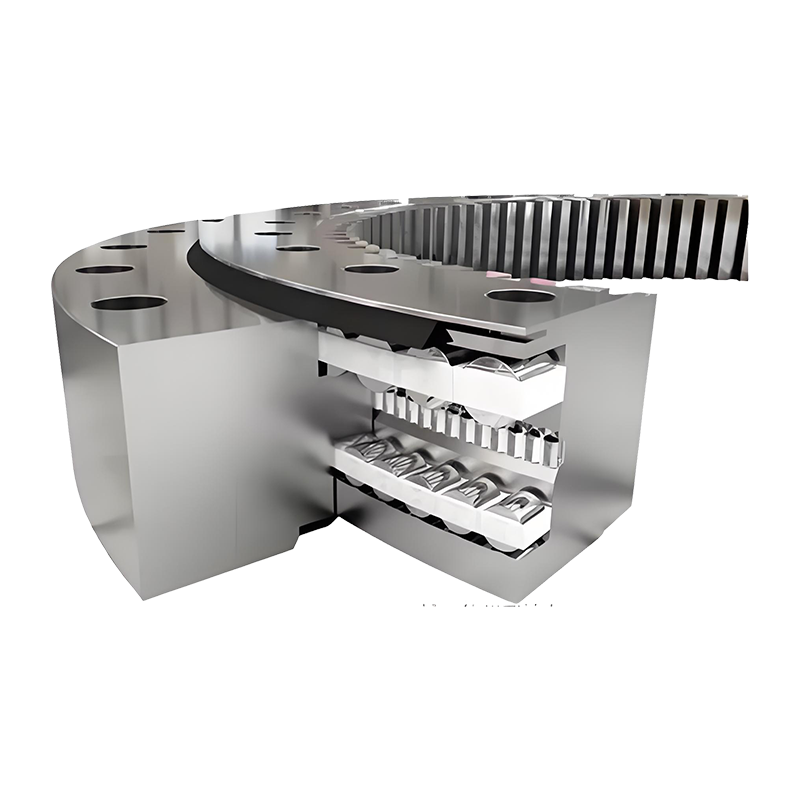 Three-Row Roller Slewing Bearing 13 SeriesBuilt for heavy-duty machines where capacity and stiffness matter more than weight and cost, with separate roller rows for axial and radial loads.View Product →
Three questions settle most of the rest: how much tilting moment the machine actually generates at full reach, whether the swing pinion is internal or external and at what module, and how much mounting height and bolt circle space is available. Get those right and the remaining specification tends to fall into place.
Working With a Manufacturer Who Knows Excavators
Almost every slew ring problem that surfaces on a machine years later began as a specification decision. That is why it helps to involve the bearing maker while the design, or the rebuild, is still on paper.
We are Jiangsu Manchen Transmission Technology, and we have been designing and manufacturing slewing bearings and slewing drives from our base in Jiangyin, Jiangsu. Our range covers single row ball, double row ball, cross roller, L-type and three row roller bearings, along with slewing drives for powered attachments. Production runs on a digital, data-monitored line, which means a bearing can be traced back through its machining and heat treatment, and delivery dates are built on real capacity rather than optimism.
Our products rotate equipment in engineering machinery, port machinery, industrial robots, medical devices and solar trackers. If you are working out which slew ring belongs on an excavator, send over the load case and the mounting drawing; that conversation usually saves more time than any catalogue.
A slew ring is easy to ignore while it is working. It stays quiet, holds the house steady, and lets a full bucket swing across the tracks without a shudder. Give it clean grease, sound seals and correct bolt tension, and it will keep doing that for years. When replacement does come, match the bearing type to the loads the machine genuinely sees, and the next swing will feel as tight as the first.
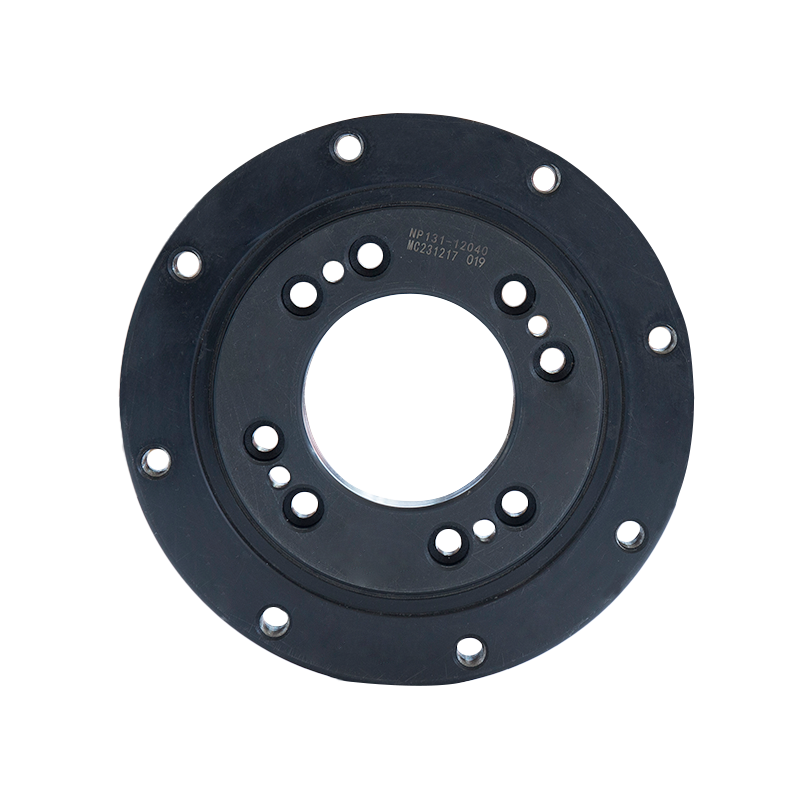

Jiangsu Manchen Transmission Technology Co., Ltd. excels in creating custom, reliable, and precise slewing bearings for diverse industries, continuously innovating to meet the highest standards and seeking collaborative opportunities. Reliable and steady slewing bearings supplier in China.
Product links
Contact Us
-
Address:No. 8, Nanqiu Road, Huangtu Town, Jiangyin City,China
-
Tel:+86-13646122221
-
Phone:+86-18796936198
-
WhatsApp:+86 18796936198
-
E-mail:hedy@slewingbearingcn.com
-
E-mail:ma@slewingbearingcn.com
-
E-mail:vena@slewingbearingcn.com
